
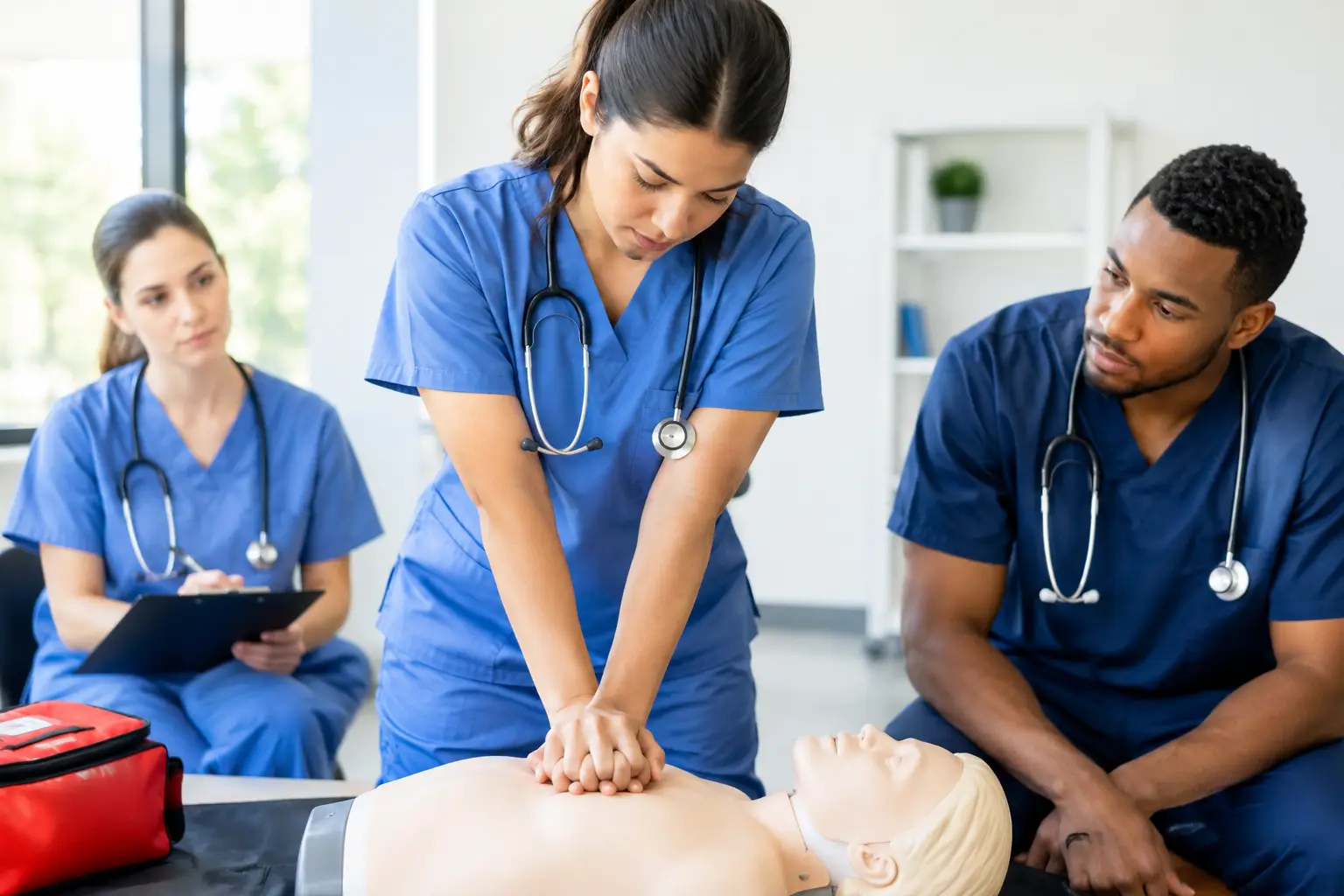
A patient becomes unresponsive in the waiting room. Another staff member calls 911 while the provider prepares to respond. As a medical assistant, you may be the person who begins CPR, retrieves the AED, or helps organize the response before EMS arrives. A BLS class for medical assistants prepares you for that moment with practical, team-based skills designed for healthcare settings.
BLS certification is often an employment requirement for medical assistants, but the right class should offer more than a card. It should help you recognize cardiac arrest quickly, deliver high-quality CPR, use an AED with confidence, and work effectively alongside other clinical professionals. Choosing the appropriate course protects your career and strengthens the level of care your practice can provide.
Why Medical Assistants Need BLS Training
Medical assistants work close to patients in fast-moving environments. Depending on the practice, you may take vital signs, assist with examinations and procedures, prepare patients for treatment, communicate clinical information, and help maintain a safe office flow. Even in a routine outpatient setting, emergencies can happen without warning.
Basic Life Support, commonly called BLS, is intended for healthcare professionals and trained personnel who may respond as part of a team. The training focuses on immediate action during cardiac arrest, respiratory emergencies, choking, and similar life-threatening events. It is more clinically focused than a general community CPR class.
For a medical assistant, BLS training builds the ability to act while staying within your role and your office’s emergency procedures. You are not expected to replace a physician, nurse, or EMS crew. You are expected to recognize a crisis, start the appropriate lifesaving steps, communicate clearly, and support an organized response.
Many employers require BLS certification at hiring and throughout employment. Medical offices, urgent care centers, specialty practices, ambulatory surgery centers, hospitals, and educational programs may each have their own policy. Before enrolling, confirm which credential your employer, school, licensing organization, or prospective employer accepts.
What a BLS Class for Medical Assistants Covers
A quality BLS course is hands-on. You will not simply watch a presentation and answer questions. You should practice core skills with an instructor who can correct technique, answer questions, and help you understand how the steps apply in a real clinical setting.
Most healthcare-provider BLS courses cover adult, child, and infant CPR, use of an AED, relief of choking, rescue breathing, and the response to opioid-associated emergencies. You will also learn high-performance CPR concepts, including proper compression depth and rate, allowing full chest recoil, minimizing interruptions, and switching rescuers efficiently when another trained person is available.
The team-response portion matters in a medical office. A cardiac arrest scene can become disorganized quickly if everyone tries to lead at once. BLS instruction teaches responders to divide tasks, communicate closed-loop instructions, coordinate compressions and ventilation, and use available equipment without unnecessary delays. These skills are particularly valuable when your practice has a small staff and every person has a defined responsibility.
Training also reinforces the limits of BLS. Your office may have additional emergency equipment, medications, or policies, but those procedures are separate from a standard BLS course. Follow your employer’s protocols, scope-of-practice rules, and direction from the clinical provider or responding EMS personnel.
BLS vs. CPR: Why the Distinction Matters
People often use BLS and CPR as if they mean the same thing. CPR is a central skill within BLS, but the courses are not always interchangeable.
General CPR and First Aid courses are excellent for parents, teachers, coaches, babysitters, workplace teams, and community members. They teach vital emergency-response skills for people who may be first on scene. BLS is specifically structured for healthcare professionals and others who may respond in a professional care environment.
The difference can affect job eligibility. If a job posting says “BLS for Healthcare Providers,” a general adult CPR course may not meet the requirement, even when it includes an AED component. On the other hand, some nonclinical medical-office roles may only require CPR/AED training. The deciding factor is the policy of the employer or program, not the course name that sounds closest.
When in doubt, ask before registering. Request the exact accepted certification standard and whether the organization requires American Heart Association BLS, American Red Cross BLS, or another approved provider credential. That small step can prevent the inconvenience and expense of taking a second course.
How to Choose the Right Course
Start by verifying that the class is designed for healthcare professionals. The course description should clearly identify BLS or Basic Life Support and explain the credential you will receive. A legitimate provider course should include skills practice and an instructor-led evaluation, whether the class is held fully in person or uses a blended format with online coursework followed by an in-person skills session.
Then consider the practical details that affect whether you can complete training successfully. Course availability, location, renewal timing, and certification turnaround all matter. Medical assistants often balance clinic hours, school obligations, family responsibilities, and commuting, so a convenient class can make compliance much easier.
Look for experienced instructors who can teach beyond the slides. The best instructors explain why a step matters, demonstrate the correct technique, and create a setting where students can ask direct questions. Real emergency scenes are rarely quiet or perfectly timed. Calm, practical instruction helps students retain the skills when pressure is high.
For offices with several employees due for renewal, private group or on-site training may be the more efficient option. Training together allows staff to practice roles they would use in their own workplace, such as who calls 911, who meets EMS, who retrieves the AED, and who documents the event. It also reduces the operational burden of sending employees to separate public classes.
Initial Certification and Renewal Are Not the Same Experience
If you are new to the medical assistant field, allow enough time for an initial BLS course. First-time students often benefit from a full classroom session where they can practice repeatedly and become comfortable with the equipment and sequence of care.
Renewal students may know the material, but refresher training should never become automatic. Guidelines, equipment, and workplace processes can change. More commonly, skills fade when they are not used. A renewal course is an opportunity to correct habits, sharpen compression quality, and regain confidence in a team response.
Do not wait until the last day your credential is valid. Employers may remove staff from clinical duties when required certification expires, and a last-minute schedule conflict can leave you scrambling. Check your card early, review your employer’s renewal policy, and schedule training with room to spare.
Prepare for More Than the Skills Test
You do not need to arrive as an expert. You do need to be ready to participate. Wear comfortable clothing because CPR practice requires kneeling, bending, and repeated chest compressions. Arrive on time, complete any required online portion before class, and bring identification or prior certification information if requested.
During training, focus on technique rather than trying to memorize every sentence. Ask the instructor to watch your hand placement, compression depth, ventilation seal, and AED sequence. If you have a physical limitation that may affect floor-based practice, communicate it before class so the instructor can discuss appropriate options.
After certification, make the training useful at work. Learn where your office keeps its AED, emergency supplies, oxygen if applicable, and posted emergency protocols. Know who is responsible for calling 911 and which entrance EMS should use. Those details are specific to your workplace, yet they can save critical seconds.
Build Confidence for the Moment It Counts
BLS certification is a professional requirement for many medical assistants, but its value is far more personal. It means that when a patient, coworker, visitor, or family member needs immediate help, you have practiced the actions that can keep blood and oxygen moving until advanced care arrives.
East Coast Safety Consulting provides practical, instructor-led BLS training for healthcare professionals who need a recognized credential and the confidence to use it. Whether you are entering the field, renewing an expiring card, or coordinating training for an entire medical office, choose a course that treats preparation as more than paperwork. The right class helps you stay sharp, respond with purpose, and be ready when your training matters most.