
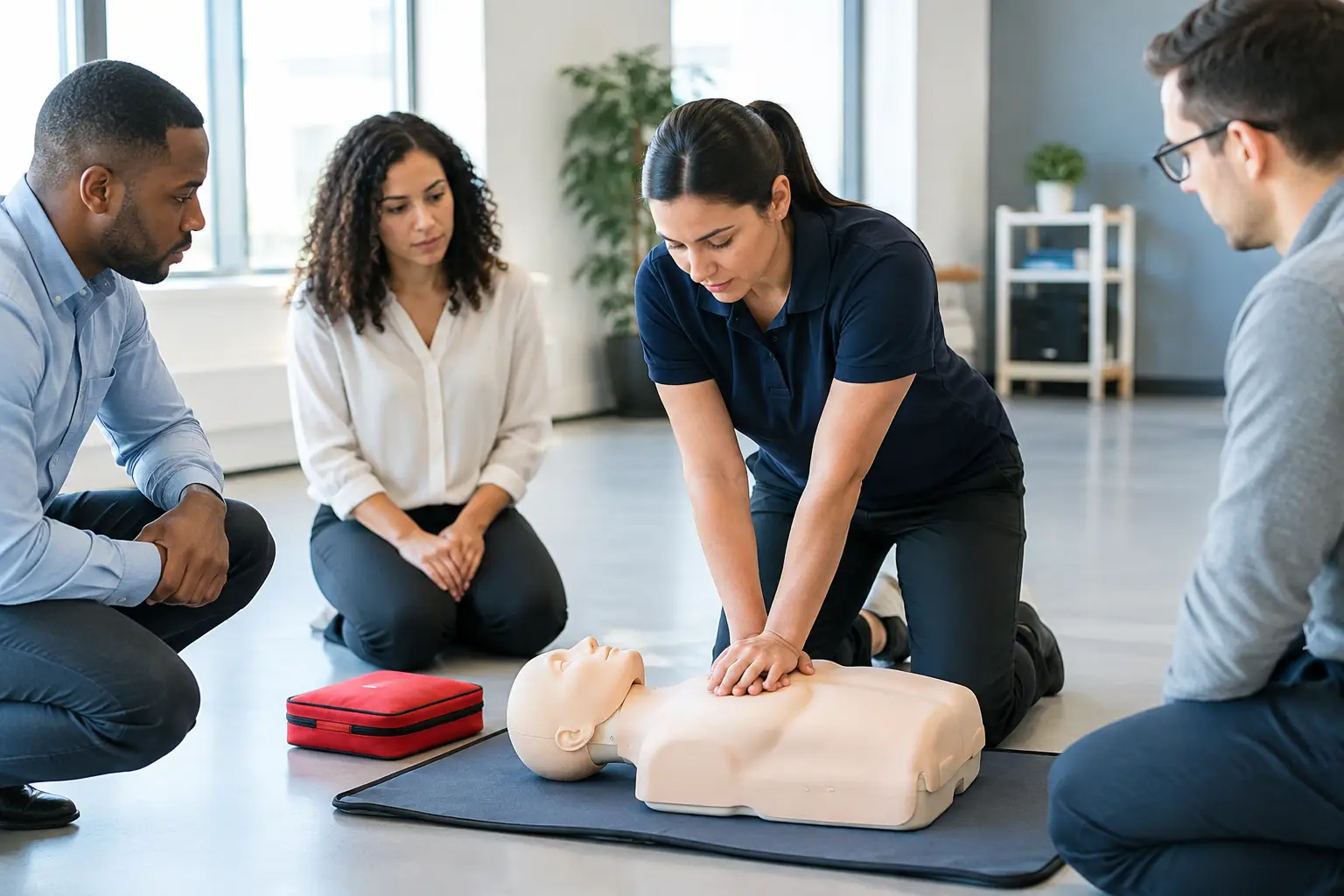
A medical emergency does not wait for a convenient time, a full staff meeting, or the next available training date. Effective workplace CPR program planning gives employees a clear path from seeing an emergency to calling for help, starting care, finding the AED, and supporting responders when they arrive. The goal is not simply to collect certificates. It is to build confidence and readiness when seconds matter.
For employers, schools, medical offices, childcare programs, property teams, and community organizations, the best plan reflects the people, space, risks, and operating hours of the organization. A small office with ten employees needs a different approach than a large warehouse, busy apartment community, or multi-shift retail operation.
Start With the Real Risks in Your Workplace
Begin by looking at the environment your people work in every day. Consider how many employees, visitors, customers, students, residents, or patients may be on site. Look at shift coverage, the physical size of the facility, isolated work areas, public access, and how long emergency medical services may take to reach the scene.
This is also the time to consider the work itself. A fitness center, construction site, healthcare office, school, restaurant, and corporate office each present different first aid concerns. Cardiac arrest can happen anywhere, but certain workplaces may also need greater preparation for choking, severe bleeding, heat illness, allergic reactions, falls, or pediatric emergencies.
A practical assessment should answer a simple question: if someone collapsed in the least convenient part of your facility at the busiest or quietest time of day, who would respond and what would they need? That question often exposes gaps that a certification roster will not.
Choose the Right Training Level
CPR training should fit employee responsibilities and organizational needs. Many workplaces benefit from adult First Aid/CPR/AED training for designated responders and other staff members who want to be prepared. Teams that regularly serve children should consider pediatric training. Healthcare professionals and clinical staff may require BLS Provider certification based on their role, employer policy, licensing requirements, or facility standards.
There is a trade-off between training everyone and focusing only on a small response team. Training a limited group can reduce cost and time away from work, but it creates vulnerability when those employees are absent, on break, traveling, or working another shift. Training every employee strengthens the culture of readiness, though it may require more scheduling coordination.
For many organizations, the most workable approach is to identify trained responders across departments and shifts while making CPR and AED education available more broadly. The right ratio depends on your building layout, headcount, turnover, public traffic, and risk profile.
Confirm Which Credential You Need
Not every CPR card meets every requirement. Before scheduling a class, confirm whether your organization, regulator, insurer, licensing board, or client contract requires a particular curriculum or credential. American Heart Association and American Red Cross programs are nationally recognized options, but the required course can vary by profession and setting.
Avoid assuming that an online-only course, a general CPR class, or a card held by a new hire will meet your workplace requirement. Confirm the accepted program, whether hands-on skills are required, and when renewal is due. That small step can prevent an expensive rescheduling problem later.
Build Coverage Into the Schedule
A CPR program fails quietly when all trained employees work the same shift. Schedule with coverage in mind. Identify who is present during opening and closing hours, evenings, weekends, overnight shifts, and periods of high customer or visitor activity.
Create a simple internal roster that shows trained personnel by location, department, and shift. Keep it current when employees transfer, leave, change schedules, or take extended leave. Supervisors should know where that roster is maintained, but it should not replace employees taking action in an emergency. Anyone who witnesses a collapse should call 911, send someone for the AED, and begin care if trained and able.
For organizations with frequent turnover, consider setting a regular training cycle instead of waiting until certifications expire. Quarterly or semiannual group sessions can make onboarding easier and reduce the risk of finding out too late that several key responders need renewal at once.
On-site workplace training can be especially useful for teams with varied schedules or a large number of employees. It allows instruction to be organized around your operation rather than requiring staff to find individual class times. For Central New Jersey employers, East Coast Safety Consulting can help structure private group instruction around workplace needs and available scheduling windows.
Make the AED Part of the Plan
An AED is only valuable when people can find it quickly and feel prepared to use it. If your organization has an AED, include it in the training conversation, not just the facilities checklist. Staff should know its exact location, how to access it, and who is responsible for checking its readiness.
Inspect the device according to the manufacturer’s guidance and your internal policy. Confirm that pads and batteries are within date, signage is visible, cabinets are accessible, and any required status indicators show the unit is ready. If the AED is stored behind a locked door, in a manager’s office, or in a room that closes after business hours, rethink whether it can be reached during a real emergency.
Large facilities may need more than one AED. Placement depends on building size, floor plan, population, and response time. A device located too far from a gymnasium, lobby, production floor, or remote wing may not serve its purpose. Facilities and safety leaders should review placement whenever the layout or operations change.
Define What Happens Before EMS Arrives
People respond better under pressure when they have practiced the first few actions. Your written emergency procedure does not need to be lengthy, but it should be specific. Decide who calls 911, who retrieves the AED, who meets emergency responders, and who directs them to the scene.
For a larger site, assign roles that can be adapted based on who is present. A receptionist may call 911 and keep the line open. A nearby employee may retrieve the AED. A supervisor or security team member may meet responders at the entrance and guide them through the facility. In a small business, one person may need to delegate these tasks aloud while starting CPR.
Include practical details that are easy to overlook: the facility address, suite number, the best entrance for responders, gate or elevator access, and whether someone must unlock an interior door. Post emergency information where it is useful, such as near phones, break rooms, security desks, reception areas, or AEDs.
Practice Communication, Not Just Skills
CPR classes teach essential hands-on skills. Workplace readiness also depends on communication. During a brief safety meeting or drill, let employees practice saying, “Call 911,” “Bring the AED,” and “Meet EMS at the front entrance.” Clear, direct language reduces confusion and prevents several people from assuming someone else made the call.
A drill should not be theatrical or disruptive. Even a five-minute walk-through can reveal that staff do not know the AED location, a door requires a key, or the emergency address posted near the phone is outdated. Treat those discoveries as improvements, not failures.
Keep Records Without Treating Them as the Program
Training records matter for compliance, renewal planning, and staffing decisions. Keep a secure record of course completion dates, expiration dates, course types, and employee roles. Set reminders well before renewal deadlines, especially for positions where certification is required.
Still, paperwork is not proof of operational readiness. A person may hold a current card and still be unsure where the AED is located or how to direct EMS through a complex building. Review your plan after staff turnover, a facility move, an incident, an AED deployment, or a major operational change.
Be careful about promising outcomes that training cannot guarantee. CPR and AED education prepares people to act quickly and appropriately, but every emergency is different. Your organization should also review applicable local, state, industry, and insurance requirements with the appropriate legal, regulatory, or risk-management resources.
Give Your Team a Plan They Can Use
The strongest workplace CPR program is not the one with the most complicated binder. It is the one employees understand, leaders maintain, and trained responders can carry out on an ordinary Tuesday when an emergency becomes very real. Schedule the right course, place and maintain the AED thoughtfully, build shift coverage, and revisit the plan before a crisis forces the issue. Prepared teams give someone in need a better chance at the help they deserve.
Leave a Reply