
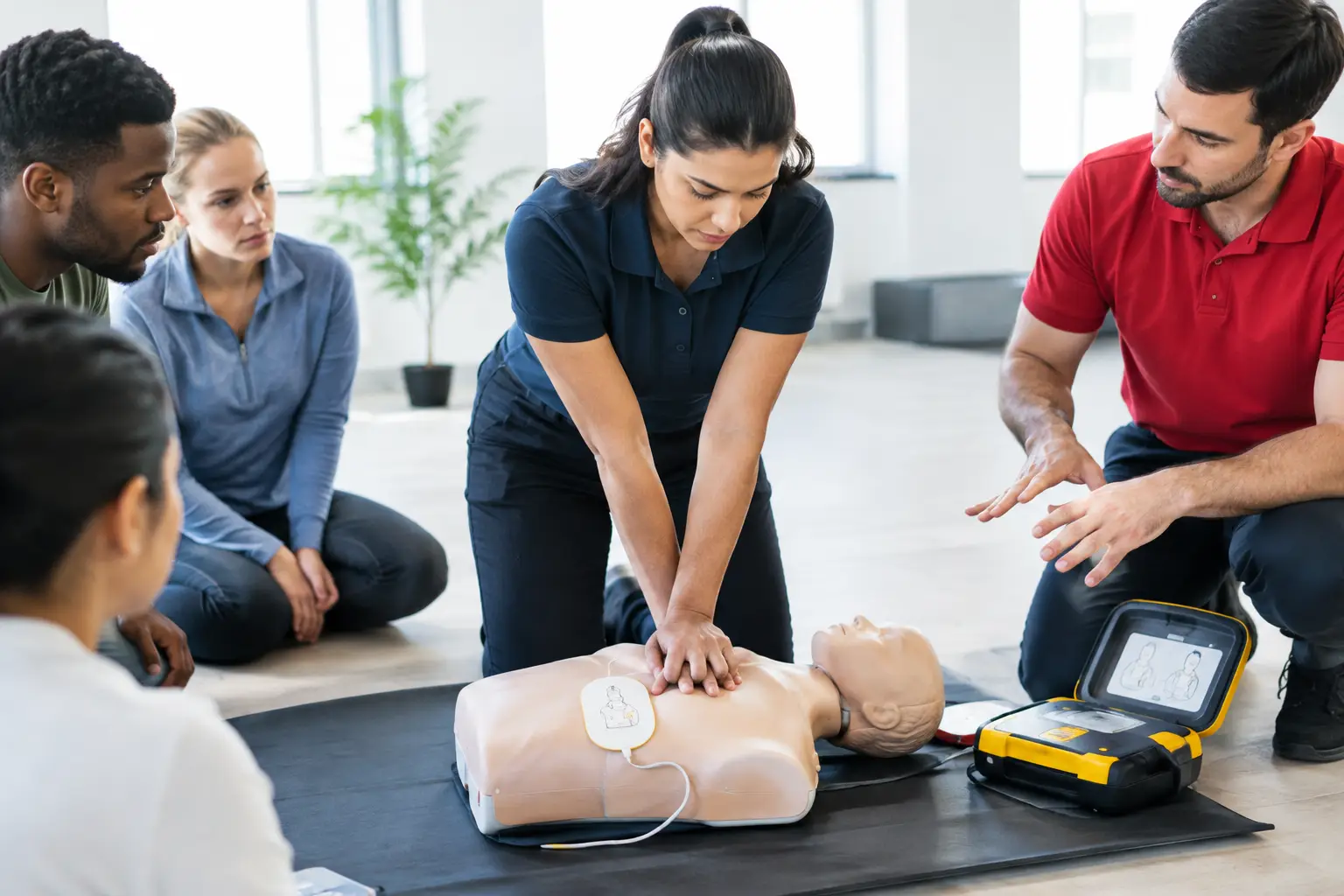
When someone suddenly collapses and is unresponsive, the first minutes matter more than most people realize. An AED training session gives you a clear, practiced response for that moment: recognize a likely cardiac arrest, call for help, begin CPR, and use an automated external defibrillator without losing valuable time.
For employers, schools, medical offices, coaches, parents, and community organizations, AED training is not simply a certification requirement. It is a practical way to prepare ordinary people to take effective action while emergency responders are on the way. The goal is not to turn participants into paramedics. It is to make sure they can stay focused, follow proven steps, and use the equipment available to them.
What an AED Training Session Teaches
An AED is designed to analyze a person’s heart rhythm and, when appropriate, advise a shock to help restore a rhythm that can support circulation. Modern AEDs are made for use by trained lay rescuers as well as healthcare professionals. They give clear voice prompts, but training matters because an emergency is stressful, fast-moving, and rarely as orderly as a demonstration.
A quality class connects AED use to the full cardiac arrest response. Participants learn how to check for responsiveness, identify absent or abnormal breathing, direct someone to call 911, ask another person to retrieve the AED, and begin high-quality CPR. This sequence matters because defibrillation works best when it happens quickly, while CPR helps maintain blood flow until the AED is ready and emergency medical services arrive.
During hands-on practice, students work with training AEDs and CPR manikins. They learn to turn the device on, expose the chest, place the pads correctly, connect them if needed, and follow every prompt. They also practice making sure nobody is touching the person while the AED analyzes the rhythm or delivers a shock. Repetition helps replace hesitation with a usable routine.
The difference between a device demonstration and real training
Watching someone operate an AED is helpful, but it is not the same as doing it yourself. In a true training environment, participants have the opportunity to handle the pads, manage the cord, work through prompts, and coordinate with another rescuer. Those details can feel small in a classroom. In a real emergency, they are exactly the details that can slow a response if they have never been practiced.
Training also addresses the situations people worry about. What if the person has a wet chest? What if they have a medication patch? What if they have a visible implanted device? What if they are a child? Instructors explain the appropriate response and reinforce a key principle: follow the AED’s prompts, minimize interruptions in CPR, and call 911 as soon as possible.
Why CPR and AED Skills Belong Together
An AED is a critical tool, but it is not a replacement for CPR. In many cardiac arrests, rescuers need to provide chest compressions before the AED arrives, while pads are being applied, and after the device has analyzed or delivered a shock. A CPR/AED course teaches participants how these actions fit together rather than treating each skill as a separate task.
For example, in a workplace emergency, one employee may call 911 and meet responding EMS personnel, another may retrieve the AED, and another may begin compressions. A trained team can divide those responsibilities quickly. When only one person is present, training provides a sequence that helps them prioritize without becoming overwhelmed.
The best response also depends on the setting. A healthcare provider may work with clinical equipment and a response team. A teacher may be responsible for students in a gymnasium or cafeteria. A parent may be alone at home. The fundamentals remain consistent, but an experienced instructor can make the scenarios relevant to the people in the room.
What to Expect During Class
AED instruction is usually included in a CPR or First Aid/CPR/AED course, although the exact curriculum depends on the certification program and the audience. American Heart Association and American Red Cross courses have different course names, requirements, and formats. The right choice depends on whether you need training for a job, a professional license, a healthcare role, a school requirement, or personal preparedness.
Most sessions combine instructor-led discussion with hands-on skills practice. Participants should expect to spend time on the floor with manikins, practicing chest compressions and AED use. Comfortable clothing is a good idea. If kneeling or performing compressions is physically difficult, let the instructor know before class. They can explain course expectations and available options, though successful certification may still require demonstrating specific skills.
Assessment is generally based on demonstrating the required skills and, in many programs, completing a written or online knowledge check. The point is not to create pressure. It is to confirm that each participant can perform the actions safely and correctly. If certification is required for work, always confirm in advance which provider and course level your employer or licensing organization accepts.
Questions worth asking before you register
Before choosing a class, verify whether it includes adult, child, and infant CPR/AED skills, if those are relevant to your role. Childcare workers, school staff, coaches, and parents often need pediatric content, while many workplace programs focus primarily on adults. Healthcare professionals generally need BLS Provider training rather than a lay-rescuer course.
It is also smart to ask about certification timing, course format, and group options. Private on-site training can make sense for a business, school, medical office, property team, or community organization that wants staff trained together using scenarios tied to its own environment. Public classes may be a better fit for individuals who need convenient scheduling or a quick renewal.
East Coast Safety Consulting provides practical CPR, AED, First Aid, and BLS instruction for individuals and organizations, with experienced instructors who understand how to make lifesaving skills clear, usable, and relevant.
Common Concerns About Using an AED
Many people are afraid they will do something wrong. That concern is understandable, but it should not keep someone from responding. An AED is designed to assess the heart rhythm and will not advise a shock unless it detects a shockable rhythm. The device guides the user through the process with spoken or visual instructions.
Another concern is legal responsibility. Good Samaritan protections commonly apply to people who provide reasonable emergency assistance in good faith, although laws vary by state and situation. Training does not make someone responsible for every possible outcome. It prepares them to offer prompt, reasonable help within the scope of their knowledge and training.
Some participants assume AEDs are only for older adults. Sudden cardiac arrest can affect people of different ages and activity levels, including young athletes and individuals with no known heart condition. That is one reason schools, fitness facilities, offices, houses of worship, sports programs, and public venues benefit from having both accessible equipment and trained people nearby.
Keeping AED Readiness From Becoming a Box to Check
Completing a course is an important start, but preparedness needs occasional attention. Skills fade when they are not used. Regular recertification and refresher practice help people remember the sequence and maintain confidence. Organizations should also make sure employees know where the AED is located and who is responsible for checking its status.
An AED should be visible, easy to access, and maintained according to the manufacturer’s instructions. Pads and batteries have expiration dates. After an AED is used, it must be inspected, restocked, and returned to service. A device locked away in an office, hidden in a storage area, or left with expired supplies cannot provide the protection people expect.
For workplaces and schools, it can help to include AED readiness in emergency planning. Decide who will call 911, who will retrieve the device, how responders will be directed into the building, and where emergency information is kept. The plan does not need to be complicated. It needs to be known by the people expected to carry it out.
A cardiac emergency will never feel routine, even for trained responders. But a well-run AED training session gives people something far more useful than good intentions: a practiced plan, the ability to follow it, and the confidence to act when another person needs help most.
Leave a Reply