
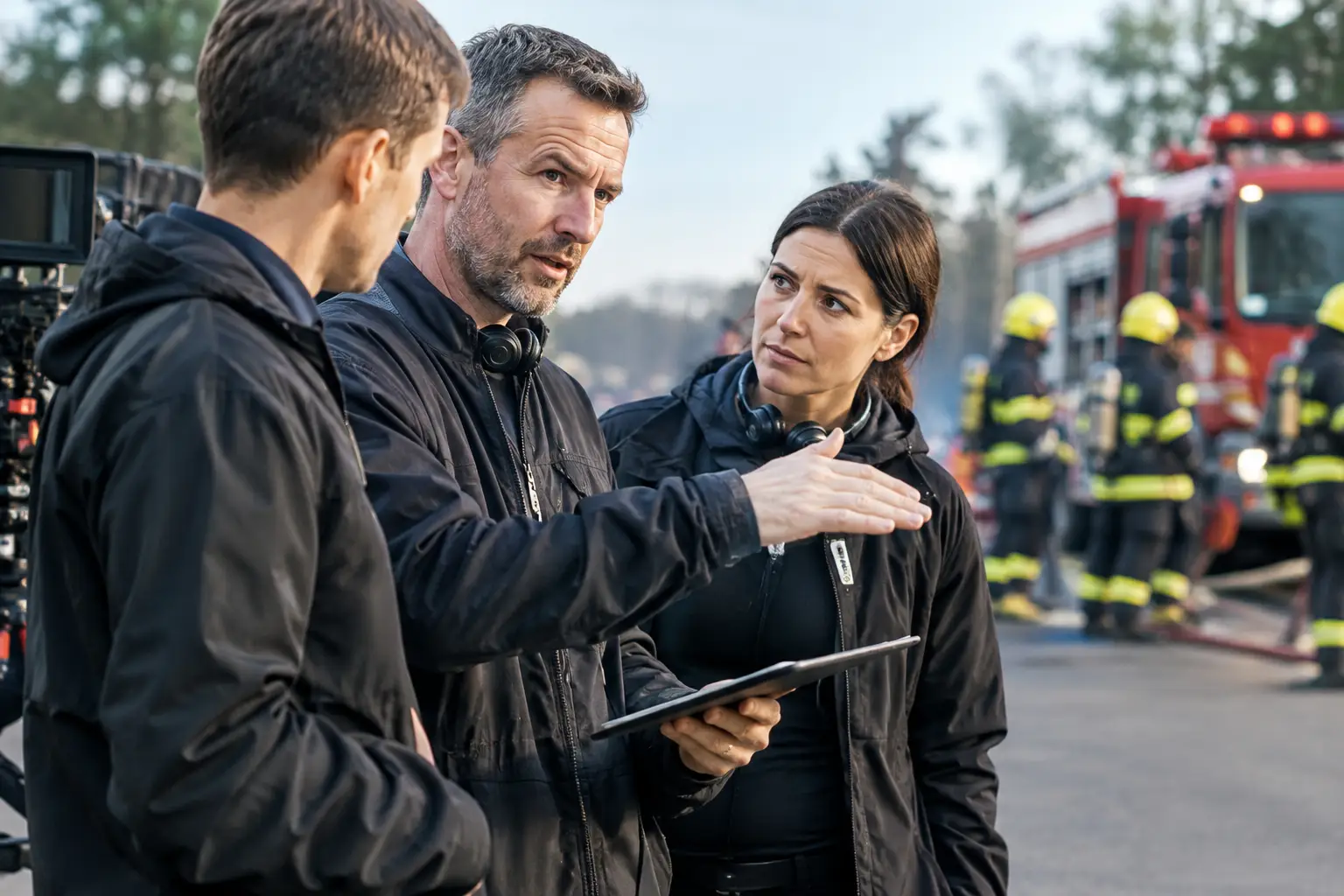
A patrol car’s lights, a medic’s radio traffic, a rushed decision at a crime scene – viewers may not know every policy or protocol, but they can usually tell when a scene feels wrong. Film consulting gives productions access to real-world public safety knowledge before small inaccuracies become costly reshoots, distracting audience reactions, or scenes that lose their emotional credibility.
For productions portraying law enforcement, emergency medical services, security, or crisis response, authenticity is not just about getting the uniform right. It is about understanding how professionals communicate, move through a scene, assess risk, use equipment, and make decisions when seconds matter.
What Film Consulting Brings to a Production
A technical consultant helps translate real procedures into material that works on screen. That may mean reviewing a script, advising a director before a complex emergency sequence, coaching performers on movement and terminology, or being available during filming to catch details that would otherwise be missed.
The goal is not to turn a dramatic production into a training video. Film and television need pacing, character, and tension. A strong consultant understands that creative choices are part of the process while helping the production avoid errors that pull viewers out of the story.
For example, a character may need to act outside normal procedure to move the plot forward. That can still feel believable when the audience understands why the character is taking that risk and when the scene reflects the real consequences of that choice. Consulting helps a production make intentional decisions rather than relying on stereotypes or outdated assumptions.
Accuracy Shows Up in the Small Details
The most convincing scenes often depend on details that do not require extra dialogue or screen time. How officers establish a perimeter, where an EMT positions equipment, how dispatch information is relayed, or which provider takes the lead during patient care can change the entire feel of a scene.
These details also affect actor performance. An actor who understands the purpose behind a command, assessment, or hand signal is more likely to deliver it naturally. Instead of appearing to recite technical language, the performer can react with the focus and urgency the role requires.
Consulting may cover practical areas such as:
- Law enforcement response, scene control, radio communication, and terminology
- EMS assessments, patient care priorities, equipment use, and responder interaction
- Public safety procedures during medical emergencies, threats, or critical incidents
- Security practices, access control, suspicious activity response, and incident reporting
- Uniforms, props, vehicles, rank structure, and realistic professional behavior
The right scope depends on the script. A short scene in a hospital hallway may only need a script review and basic actor guidance. A production centered on a major incident, police investigation, ambulance crew, or security team may benefit from early and ongoing technical support.
When to Bring in Film Consulting
The best time to involve a consultant is before filming begins. Early review can identify issues in a script before departments have ordered props, built sets, blocked action, or scheduled talent around a sequence that will need to change.
During pre-production, a consultant can help clarify what type of responder would realistically arrive, what information they would have, how long certain actions might take, and what equipment or personnel the scene requires. This gives the production team a clearer foundation for budgeting and planning.
Consulting remains valuable on set as well. Emergency scenes can change quickly because of camera angles, weather, location limitations, actor availability, or director notes. An on-set resource can help the team adjust without losing the logic of the response.
Post-production may also raise questions. If a line of dialogue is unclear, a sound cue does not match the action, or an edit creates an unintended error, a consultant can provide practical feedback before the final cut is released.
Realism Must Serve the Story
Accuracy matters, but not every real-world process belongs in every scene. Actual public safety work can involve long pauses, paperwork, waiting for specialized units, and procedures that are necessary but not visually dramatic. A production should not feel obligated to show every step.
The better question is whether the scene preserves the truth of the situation. Does the responder’s behavior make sense? Is the terminology appropriate? Does the action create a misleading impression about lifesaving care, police authority, or security responsibilities? Is a dramatic shortcut likely to confuse the audience?
There are times when a consultant may recommend simplifying an action rather than reproducing it exactly. A camera-ready version of a procedure can still be credible if it keeps the essential sequence and avoids suggesting unsafe behavior. This is especially relevant in scenes involving CPR, bleeding control, weapons, arrests, medical equipment, or distressed patients.
A consultant should be a creative partner, not a barrier to storytelling. Productions benefit most when technical guidance is discussed openly with the director, writer, props team, wardrobe department, stunt coordinator, and performers. Everyone can then work from the same realistic framework.
The Cost of Getting Emergency Scenes Wrong
Some inaccuracies are minor. A misplaced patch or slightly incorrect radio phrase may go unnoticed by most viewers. Others can have a larger impact, particularly when a production handles public safety subjects that audiences know from personal experience or professional work.
Healthcare professionals, first responders, military veterans, security personnel, and law enforcement families are often quick to notice errors. Their feedback can influence how a production is discussed long after release. More importantly, misleading scenes can create confusion about what bystanders should do in a real emergency.
Poorly staged medical care may imply that a dangerous action is appropriate. An unrealistic police response can undermine the seriousness of an investigation or critical incident. A security scene based only on movie tropes may make an organization appear careless rather than prepared.
Technical guidance helps reduce these risks while supporting safer filming practices. When a scene includes simulated weapons, physical restraint, emergency vehicles, medical devices, or high-stress action, professional input can help the crew establish clear expectations and avoid preventable mistakes.
Choosing a Film Consultant for Public Safety Scenes
Experience should match the production’s needs. A consultant with a background in law enforcement and emergency response can offer insight that goes beyond terminology. They understand how people communicate under pressure, where procedures may vary, what actions are likely to happen first, and which details are nonnegotiable for a believable scene.
Look for someone who can explain technical information clearly to people without public safety backgrounds. The most helpful consultant does not overwhelm a cast or crew with jargon. They give usable direction, answer questions directly, and recognize that a production schedule requires practical solutions.
It is also helpful to discuss expectations at the start. Determine whether the consultant will review scripts, attend rehearsals, advise on props and wardrobe, provide actor coaching, support filming days, or review edited scenes. Clear scope helps the production use the consultant’s time where it will have the greatest effect.
East Coast Safety Consulting brings law-enforcement and emergency-response experience to film and television projects that need realistic portrayals of public safety operations, emergency care, equipment, and professional communication.
Build Credibility Before the Cameras Roll
The strongest emergency scenes do more than look convincing. They help viewers understand the stakes, trust the characters, and stay focused on the story. When responders act with believable purpose, the entire production feels more grounded.
If your script includes law enforcement, EMS, security, or a critical incident, seek technical guidance early. A focused conversation before pre-production can protect the details that matter most and give your cast and crew the confidence to bring the scene to life.